© Thomas Gade / May 2015 (updated 2026)
Diesel Fuel
Engine Failure Due to Diesel Pest
Suddenly the diesel engine stops running. One possible cause is diesel pest – a tough biosludge produced in the fuel by microorganisms. This is a good reason to learn more about diesel fuel.If you have reached this page due to an acute engine failure and first want to know how to combat diesel pest, please read the article Diesel Pest first and then Measures for Diesel Pest.
Diesel from Crude Oil
Diesel is a liquid fuel obtained from crude oil. In refineries, crude oil is heated and separated under pressure into various components with different properties (density and boiling point). This separation takes place in tower-like distillation columns.The heated crude oil separates into heavy and light fractions. The heavy substances sink to the bottom, the lighter ones rise, and the lightest evaporate. The gas is then liquefied again in a cooling pipe system. This separation produces various substances that are further processed into marketable products.
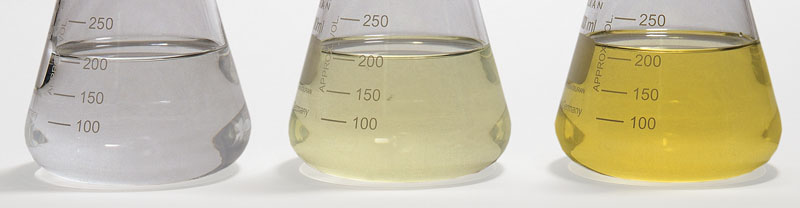
Diesel is a clear to yellowish liquid.
Source: Aral AG (edited)
Crude oil consists mainly of hydrocarbons formed through conversion processes of organic matter. Diesel is also composed of various hydrocarbon molecules.
An important process in the production of petroleum products is cracking – the breaking of long hydrocarbon molecules to obtain higher-value products and increase yield. In thermal cracking, the molecules are set into vibration at temperatures between 450 °C and 800 °C in pressure vessels (sometimes with catalysts) until they break.
However, the majority of fossil diesel fuel is produced by simple distillation of crude oil. To increase the yield, additional diesel is generated from heavier components through cracking. Commercial diesel for engines usually consists of a mixture of both processes.
Worldwide, crude oil covers about one third of energy demand. In 2015, approximately 4.2 billion tons of crude oil were consumed. As of 2024/2025, annual consumption is around 5 billion tons (approx. 102–105 million barrels per day). Proven reserves are currently estimated at about 1.7 trillion barrels, which at current consumption rates gives a statistical range of roughly 50 years.

Refinery Gelsenkirchen at night.
Source: BP Europa SE
Biodiesel
Biodiesel is produced from vegetable oils, animal waste fats, and fish oil. Depending on the region, different raw materials are used: mainly rapeseed oil in Europe, soybean oil in North America, and palm oil in Southeast Asia. Other sources include castor oil, sunflower oil, and jatropha.From an ecological perspective, biodiesel is viewed controversially. Critics point to the destruction of rainforests, monocultures, and the displacement of local populations. Supporters see it as a way to reduce the consumption of fossil raw materials. One thing is clear: we need alternatives to limited fossil fuels.
Biodiesel has different properties than fossil diesel but can be blended with it. It contains less sulfur, is biodegradable, has a higher flash point, and good lubricating properties. However, biodiesel binds significantly more water than fossil diesel and has lower oxidation stability (especially from soy and palm oil).
Fuel from Algae
The fuel industry is experimenting with alternative raw materials. In 2013, economically viable biodiesel production from algae was reported from Brazil. In closed tank silos heated by solar energy and waste heat from a sugar factory, algae multiply very rapidly while consuming carbon dioxide (CO₂).The necessary sunlight is channeled into the tanks via fiber optic cables. Compared to open ponds, the energy requirement here is significantly lower. In addition to biodiesel, omega-3 fatty acids and high-protein animal feed are produced as by-products.
The manufacturer claimed at the time that algae biodiesel was already cheaper than fossil diesel. Scientists and researchers are working intensively on such solutions. Perhaps in the future, algae containers will stand next to solar panels on house roofs, cleaning the CO₂ from combined heat and power plants.
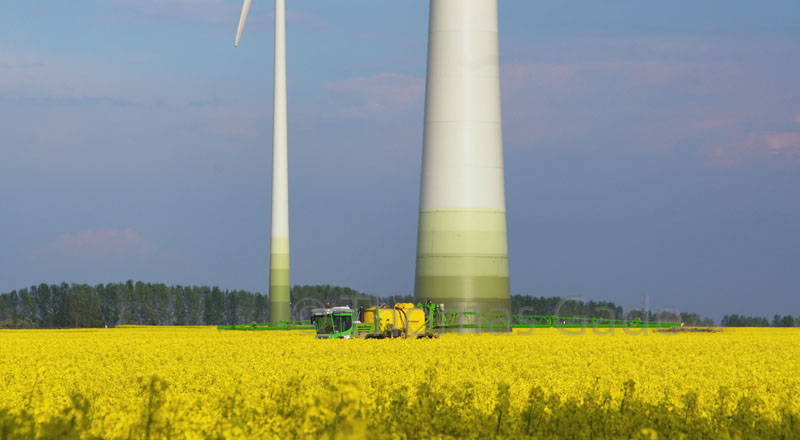
Rapeseed field with wind turbines in Brandenburg. Biodiesel is produced, among other things, from rapeseed oil.
Blending of Biodiesel
Since 2009, we have been filling up with diesel containing a legally required biodiesel component in Germany and many other European countries, in accordance with the EN 590 standard. This standard still allows a maximum of 7 % FAME (conventional biodiesel). Higher blends are possible but are not the widespread standard (B10 is approved in some countries, but not everywhere available).Fossil diesel can absorb only very little water. When mixed, the water settles at the bottom. Biodiesel, on the other hand, binds significantly more water and forms a fine emulsion. In a mixture of fossil diesel and biodiesel, part of the water is distributed as tiny droplets in the fuel. During longer periods of standing, this promotes the growth of microorganisms and the formation of biosludge.
Diesel Fuel with No or Very Low FAME Content
Vehicles with long idle periods and low fuel consumption should preferably use diesel with no or very low FAME (conventional biodiesel) content. Many premium grades such as Aral Ultimate Diesel and Shell V-Power Diesel usually contain no or only very little FAME. Instead, HVO (hydrotreated vegetable oil / renewable diesel) is often blended in, which behaves much better and is less susceptible to microbial growth.However, such statements should be viewed critically. Fuel suppliers must meet legal blending quotas. That is why premium diesel is more expensive. Regardless of this, the addition of an effective biocide is also recommended for these grades.