© Thomas Gade / May 2015 (updated 2026)
Measures for Diesel Pest
Tank Cleaning
Tanks with heavy biosludge contamination must be thoroughly cleaned. Deposits have to be removed, the fuel must be pumped out and filtered. A biocide can then be added and the diesel reused. In practice, this is more difficult than it sounds.The first challenge is determining whether biosludge is present in the tank. This requires the ability to inspect the inside of the tank. Not all tanks have sufficiently large or easily accessible openings.
Important Note: Since the end of 2018, proven biocides such as Grotamar 82 may no longer be sold to private boat owners in Germany. It is still unclear how this issue will be resolved in the long term.
Caution when working on fuel tanks!Many tanks are permanently installed in boats or vehicles and are often partially filled. Work on tanks containing highly flammable fuels (e.g. petrol) and explosive vapours is extremely dangerous and can lead to serious accidents.This article deals exclusively with diesel pest. At room temperature, diesel is difficult to ignite. Anyone who follows the measures described here does so at their own risk. We assume no liability for any damage or accidents. If you have any doubts about your own technical skills, you should definitely hire a professional company. |
Performing Tank Cleaning Yourself
In most cases the tank is not empty when you realise cleaning is necessary. Few boat owners have the means to pump out and filter large quantities of diesel. In such situations it is advisable to hire professionals. However, many boats have relatively small, accessible tanks, making DIY cleaning feasible.You will need a pump (e.g. the Proxxon 25262 oil extraction pump, 12 volt, approx. 40 €), several jerry cans, rags, disposable gloves and waste bags. Disposable nappies (diapers) are very useful for absorbing spilled diesel.
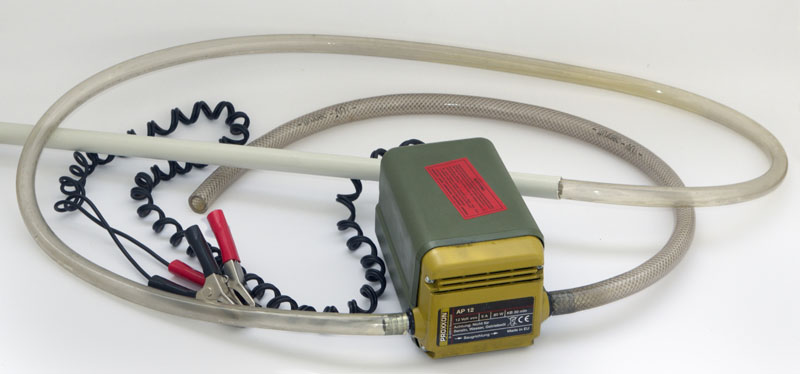
The pump has two hoses. The left hose is connected to a rigid tube that is inserted into the tank. The flexible hose alone cannot reach every spot on the tank bottom effectively.
Similar inexpensive pumps from China (€15–20) often work just as well. Long-term durability is less important at this price.
When pumping out contaminated diesel, small solid particles (metal shavings, sand) can block the pump. In this case, switch off the device, open the housing and clean the interior carefully – this is manageable with basic technical skills.
Many tanks are installed in such a way that access is very difficult. In these cases, inspection hatches must be cut into the hull and tank. The images below show an example where a permanently installed fridge had to be removed to gain access to the tank.


In this 6.2-metre cabin boat, the tank was located under a permanently installed refrigerator.
Openings on the Top of the Tank
If the tanks are easily accessible, the covers with the connections can be unscrewed, providing openings for pumping and cleaning. These openings are often not large enough to reach inside with your hand, but they are usually sufficient to insert a hose and a wooden strip with a spatula to scrape off deposits.
1. This is where the fuel gauge sender is located.
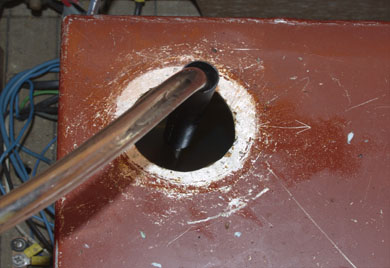
2. After removal, diesel can be pumped out here.

3. Alternative: opening of the diesel return line
Diesel tanks on boats are often divided into chambers by baffles to reduce sloshing in rough seas. Each chamber must be pumped out separately to reach the entire tank bottom with the suction tube.
When opening the covers, make sure you can refit and seal them properly afterwards. In our case, the fuel gauge sender cover shown in image 1 could not be reinstalled in the same way.

From left to right: collection canister, Proxxon oil extraction pump, hose with tube inside the tank. The pump rests on a nappy that absorbs any leaking fuel.
Filtering the Diesel
If the pumped-out diesel is cloudy and contains biosludge, the particles will settle at the bottom after some time. With smaller quantities, the clearer upper part can be carefully poured through a funnel with a coffee filter. The filtered diesel can be reused but should be consumed soon. Add a biocide as a preventive measure.Recommendation
The filtered diesel should only be returned to the tank if it will be used up quickly. Even after filtering, it will still contain microorganisms, and conventional biodiesel is not suitable for long-term storage.For sport boats with large tanks that remain unused for several months in winter, it is advisable to use a modern, stable fuel. If possible, fill up with **C.A.R.E. Diesel** – it is significantly less prone to diesel pest.
Professional Tank Cleaning and Fuel Filtering
The company **MFT Mikrofiltertechnik GmbH** in Geesthacht enjoys an excellent reputation. Their team operates throughout Europe and is familiar with almost all boat types. They can quickly determine how to access the tanks and, if necessary, install inspection hatches in the hull and tank. They pump out, filter and clean the tanks thoroughly.For a medium-sized sport boat with built-in tanks, the cost for cutting openings, tank cleaning and filtering the diesel is around €400 plus travel expenses.