The Wreck of the Queen Elizabeth off Hong Kong
2011 / 2025 © Thomas Gade
The burned-out wreck of the Queen Elizabeth off Hong Kong. Photo: Hase / Fotoarchiv Gade
The RMS Queen Elizabeth was one of the most famous ocean liners of the 20th century. Launched in 1938, she was not only the largest passenger ship in the world, but also a powerful symbol of British engineering and maritime ambition. Her owners, Cunard White Star Ltd, planned to operate her alongside her sister ship, the RMS Queen Mary, on a weekly transatlantic service between Southampton and New York. Together, the two ships were intended to secure Britain’s dominance on the North Atlantic—then the most prestigious sea route in the world.
These plans were cut short by world events. Before the Queen Elizabeth could begin her maiden voyage, the Second World War broke out. The British government requisitioned the ship and converted her into a troop transport. Her elegant livery was replaced with a grey camouflage scheme, her luxurious interiors were stripped out, and she was adapted to carry up to 15,000 soldiers—more than any other ship of her time.
With a service speed of around 29 knots and a top speed exceeding 32 knots, the Queen Elizabeth was faster than the German U-boats threatening the Atlantic. This allowed her to sail without escort, making her one of the most important transport vessels of the Allied war effort. Historians estimate that she carried several hundred thousand troops during the war—an achievement that underscores her significance far beyond civilian service.
Her importance becomes even clearer when one considers that she not only transported troops to Europe, but also brought them home again in vast numbers. On westbound crossings, she primarily carried American, Canadian, and later Australian troops, many of whom had been assembled and trained in large camps in North America. Ports on Scotland’s west coast—such as Gourock and Greenock on the Clyde—were frequent destinations, offering sheltered approaches far from the main U-boat hunting grounds.
After the war, the ship’s role changed dramatically. The immense task of repatriating hundreds of thousands of servicemen began, and the Queen Elizabeth became a key vessel in this effort, later known as “Operation Magic Carpet.” With her enormous capacity, she could carry thousands of returning soldiers on a single crossing, completing the journey in just four to five days. She also transported wounded or exhausted men, provided they were fit to travel and did not require specialist medical care.
By serving in both directions—first as a lifeline carrying Allied troops to Europe, and later as a homeward-bound transport—she achieved remarkable transport figures. Her speed, size, and reliability made her one of the most strategically valuable ships of the war.
After the conflict, the Queen Elizabeth returned to civilian service. Together with the Queen Mary, she dominated transatlantic travel in the 1950s. The pair came to embody the “Golden Age of Ocean Liners,” when crossing the Atlantic was as much a social occasion as a means of transport. Film stars, politicians, business leaders, and affluent travelers all passed through her decks. She offered multiple passenger classes, elegant lounges, expansive promenade decks, and amenities that represented the height of luxury at the time.
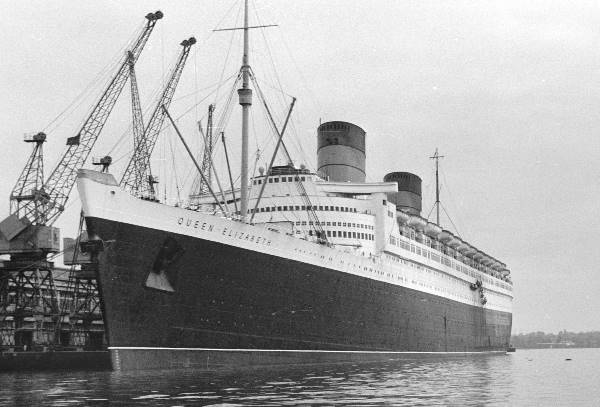
The Queen Elizabeth in the port of Portsmouth, 1955. Photo: Hellmut Münzner
This 1955 photograph shows the Queen Elizabeth in Portsmouth—a port she did not regularly call at, yet one that still played an important supporting role. Her official home port was Southampton, but Portsmouth frequently served as a stopover for maintenance, inspections, or short layovers between Atlantic crossings. At this time, she was at the height of her career: a symbol of Britain’s post-war recovery and a technical masterpiece admired around the world. Whenever she appeared in a British port, crowds would gather to catch a glimpse of the great ship.
Air travel overtakes the great liners
The world, however, was changing. With the rise of jet airliners in the late 1950s and early 1960s, transatlantic sea travel rapidly declined. Flying was faster, more affordable, and far more flexible. Passenger numbers on the great liners fell sharply. The Queen Mary was withdrawn from service in 1967, followed by the Queen Elizabeth in 1968. Cunard replaced them with the more modern Queen Elizabeth 2, which, although designed for transatlantic service, soon found its primary role as a cruise ship.
S.S. Seawise University
In 1970, the Chinese shipping magnate Tung Chao-Yung, founder of the Orient Overseas Line, purchased the Queen Elizabeth. He envisioned transforming her into something entirely new: a floating university, to be known as the S.S. Seawise University.
Tung was a passionate advocate of international education. He had closely followed the “World Campus Afloat” program, in which students from around the globe studied while traveling by sea. When the program ran into financial difficulties, he saw an opportunity to turn his vision into reality. Convinced that the global maritime economy needed highly trained professionals, he sought to create a ship that would educate future specialists.
His ambition was to establish an international academic institution at sea—one that might even, in time, support the United Nations in training maritime experts. The Queen Elizabeth was to become the heart of this project: a floating campus bringing together students from all over the world.
In January 1972, disaster struck. Under circumstances that remain unclear to this day, multiple fires broke out on board. Witnesses reported explosions, and a range of possible causes was discussed. During the firefighting efforts, the ship took on water, capsized, and came to rest on her side in Hong Kong harbour.
Despite the loss, Tung did not abandon his vision. He acquired a smaller vessel, the SS Atlantic, and continued the project in cooperation with several universities, including the University of Pittsburgh. This initiative eventually evolved into the “Semester at Sea” program, which still sends hundreds of students on an academic voyage around the world each year. The idea that began with the Queen Elizabeth did not sink with her—it simply found new life aboard other ships.
Rumours and speculation about the fire
The cause of the 1972 fire has never been conclusively established. At the time, authorities in Hong Kong pointed to multiple independent fire sources and described the circumstances as unclear. This left room not only for theories of accident or technical failure, but also for more speculative explanations. No definitive conclusion was ever reached.
A likely explanation is that the fire was linked to the extensive conversion work underway. Welding, cutting, and installation were being carried out throughout the ship, and flammable materials from her previous use were still present in some areas. Under such conditions, even a small spark could have triggered a blaze. However, the near-simultaneous outbreak of fires in several locations led some observers to suspect that more than a simple accident might have been involved.
Contemporary reports and later accounts also explored possible financial or business motives. The Seawise University project was ambitious, costly, and not without internal tensions. In that context, the possibility of deliberate damage was occasionally raised—but no concrete evidence has ever emerged to support such claims.
Political and emotional factors were also part of the public debate. The Queen Elizabeth had long been a symbol of British maritime heritage, and her sale to a Chinese owner was not universally welcomed. Some commentators speculated about wounded national pride or rivalries within the global shipping industry. Such ideas, however, remain purely speculative, with no solid evidence to support them.
Most historians agree on one key point: the true cause of the fire was never determined. Various theories exist, but none has been proven. As a result, the loss of the Queen Elizabeth remains not only a maritime disaster, but also one of the enduring mysteries of seafaring history.
Insurance and financial aftermath
Insurance issues also played a significant role in the aftermath of the fire. Contemporary reports suggest delays and negotiations, as the unusual circumstances prompted insurers to examine multiple scenarios. Compensation was ultimately paid, although the exact amount was never disclosed. What is clear is that Tung Chao-Yung was not financially ruined by the loss. On the contrary, he was able to pursue his vision of a floating university using another vessel. As in many aspects of the case, the details remained confidential, and much of what is known today is based on indirect sources and later accounts.
In the years that followed, the wreck became an unusual tourist attraction. Excursion boats carried visitors out daily to view the capsized giant. Many of the surviving photographs were taken from these small vessels as they circled the wreck. What visitors saw was both haunting and fascinating: a vast, tilted steel structure slowly succumbing to rust.
The wreck even found its way onto the silver screen. In the 1974 James Bond film The Man with the Golden Gun, starring Roger Moore, it serves as an unconventional base for the British Secret Service. In the film, Bond is taken to Hong Kong and apparently arrested, only to be transported by boat to the wreck itself. Inside, a makeshift MI6 headquarters has been constructed, its interiors tilted to match the angle of the capsized ship. The filmmakers used the still-visible silhouette of the wreck as a striking backdrop, creating one of the most unusual secret service settings in the entire Bond series.
In 1974, work began to dismantle the wreck, a process that continued into 1975. Not all parts could be salvaged. At the time, Hong Kong was expanding through land reclamation, and the remaining sections of the ship were buried under sand, earth, and fill. Today, part of a busy container port stands on the site—directly above the remains of what was once a legendary ocean liner.
While browsing the Fotoarchiv Gade / medienarchiv.com, we came across these rare images of the Queen Elizabeth—later Seawise University—during the final, tragic chapter of her existence off Hong Kong.
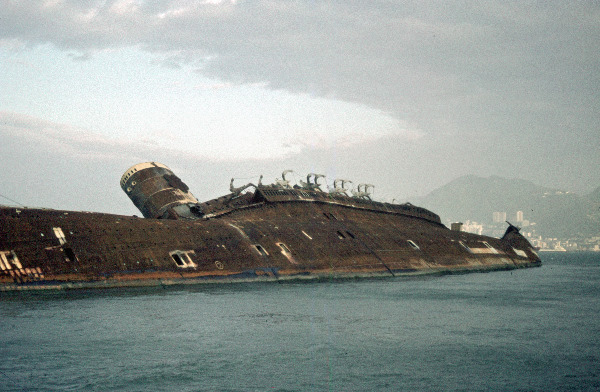
The burned-out wreck of the Queen Elizabeth. Photo: Hase / Fotoarchiv Gade
Read also:
1967: Voyage from Hamburg to Valparaíso aboard the Hornbelt